Platform
Six surfaces, one source of truth
NODAVX is a graph store, a live projection of it, and a disciplined path from a question to a committed change. Nothing on the screen is a second copy of the truth.
Build state
What is implemented today
Every row below was exercised through the public HTTP surface, not unit-tested in isolation.
| Surface | State | Evidence |
|---|---|---|
| Vertex | Built | 584 entities in the commercial pack and 615 in defense, each typed, scoped to a workspace, searchable and inspectable. |
| Edge | Built | 1,507 native record links in the commercial pack and 1,502 in defense, with declared cardinality; traversal is one query, and removing a node removes its edges from the snapshot. |
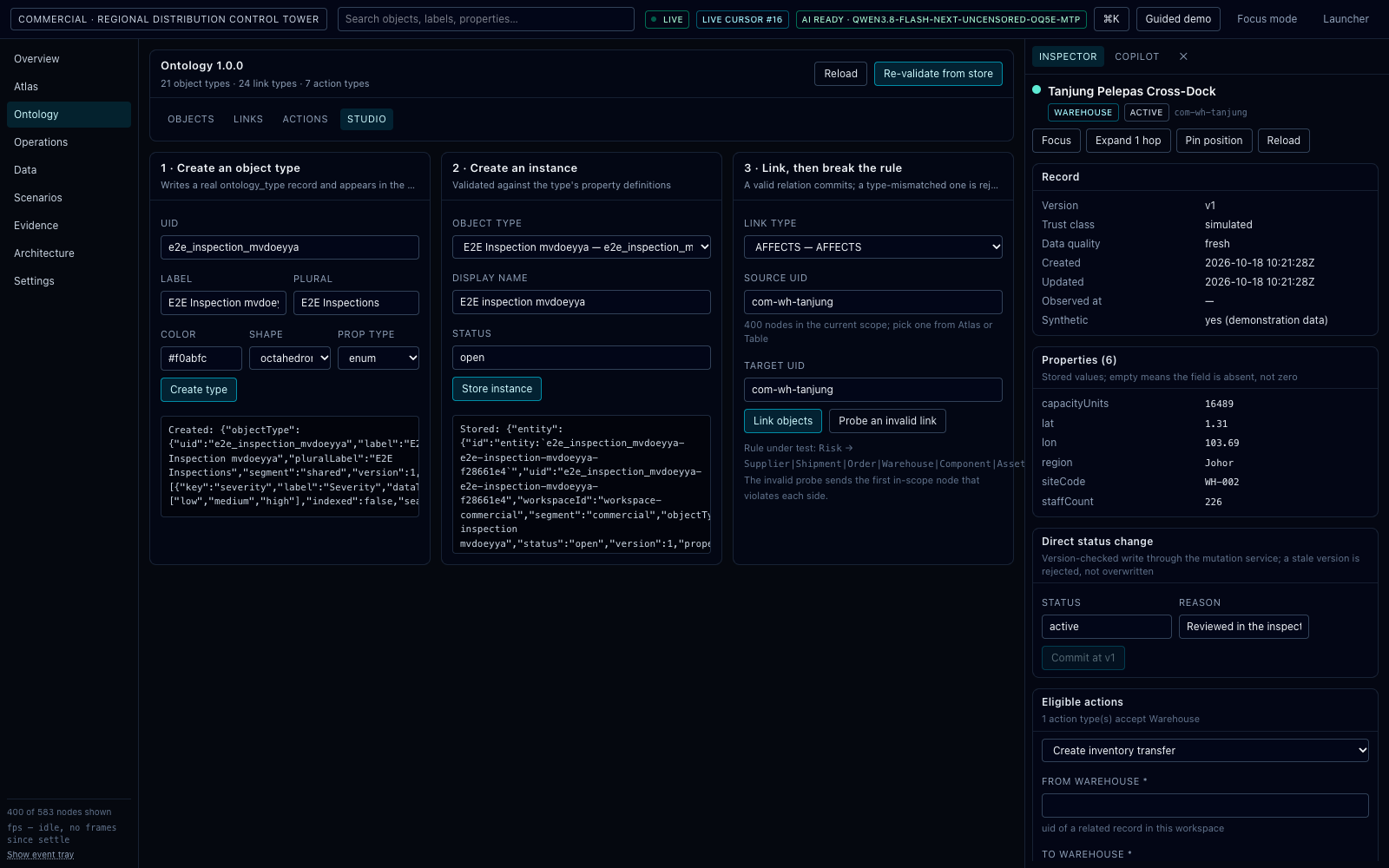
| Meta | Built | Ontology Studio creates and edits object and link types at runtime; an invalid link is rejected with the rule that broke. |
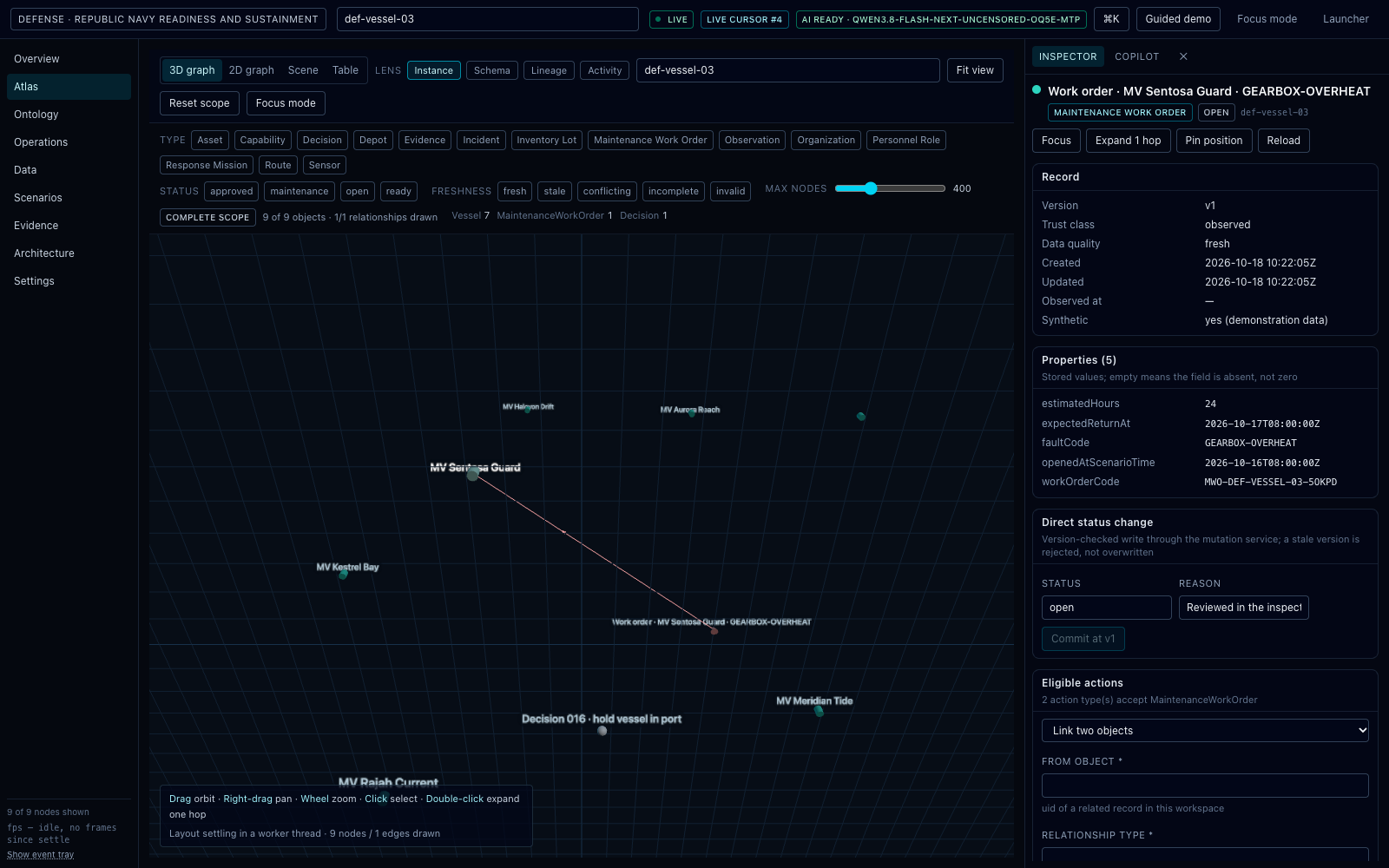
| Atlas | Built | R3F scene with worker-side d3-force-3d layout, filters, lenses, selection, and a history replay mode. |
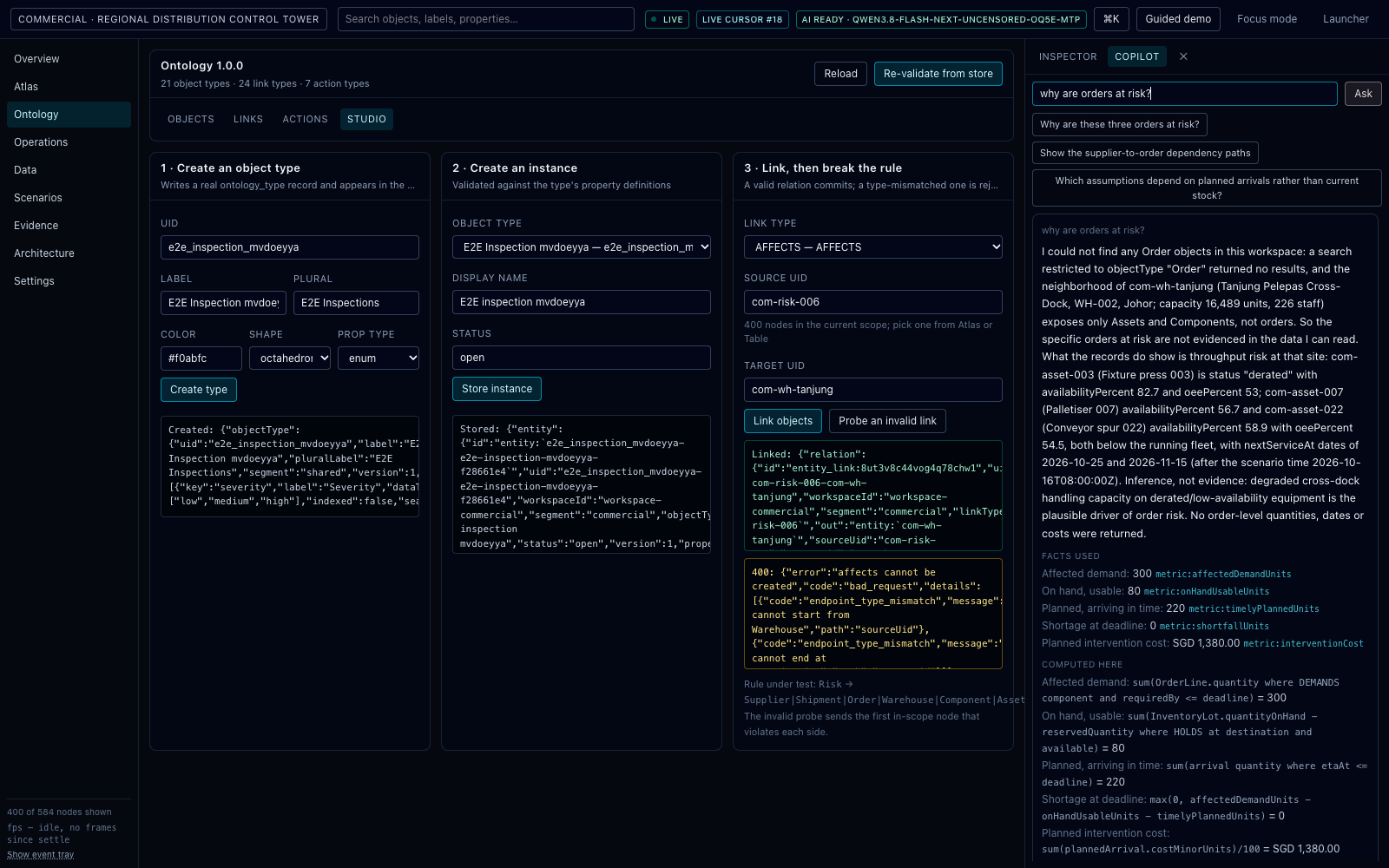
| Reason | Built, single-user | Retrieval plus graph grounding with clickable citations and a supporting-subgraph action. Vector search is off until an embedding model is verified. |
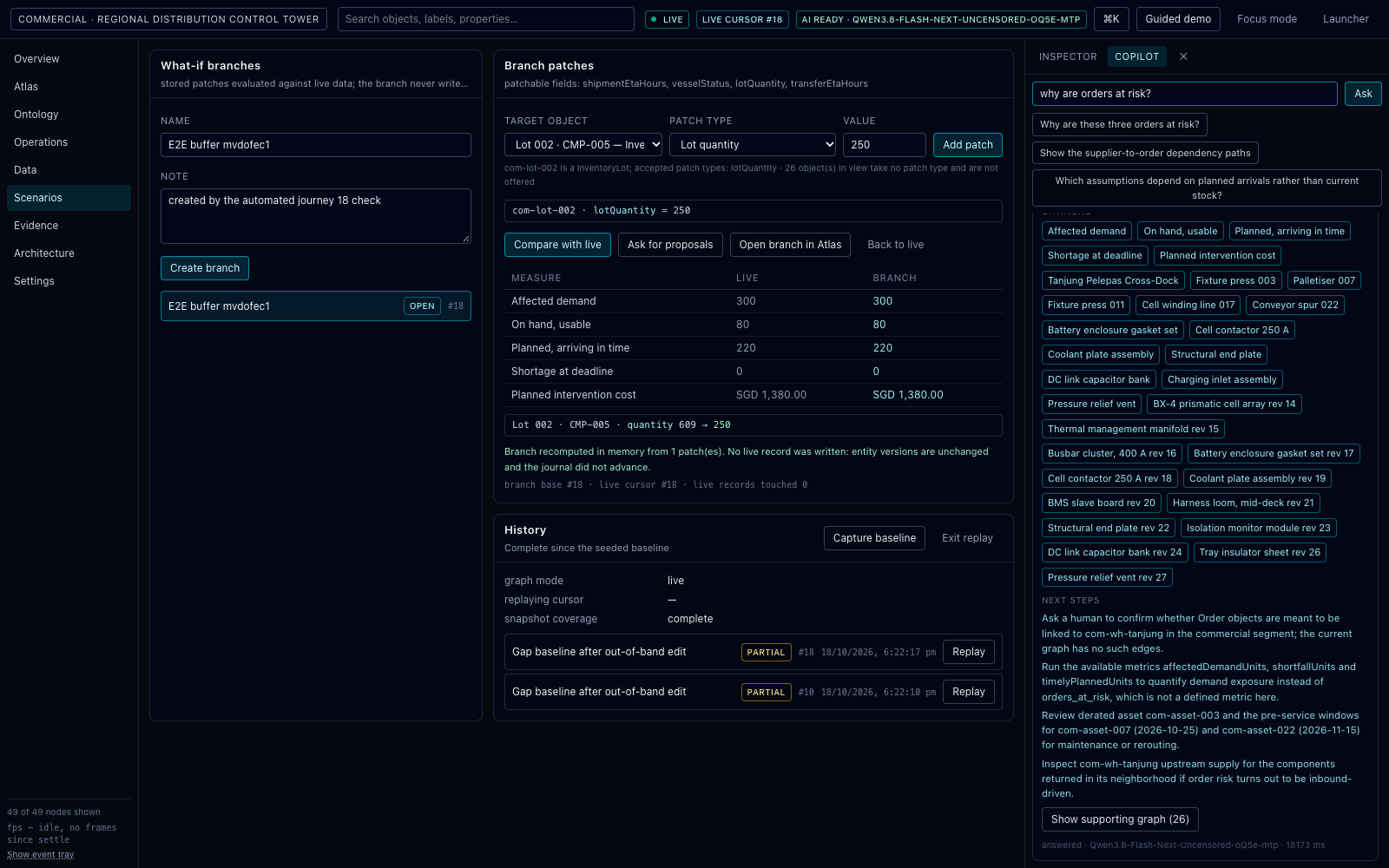
| Twin | Built, single-user | Scenario branches, patches, compare, reviewed action preview/commit with idempotency, and a replayable journal. |
Screens
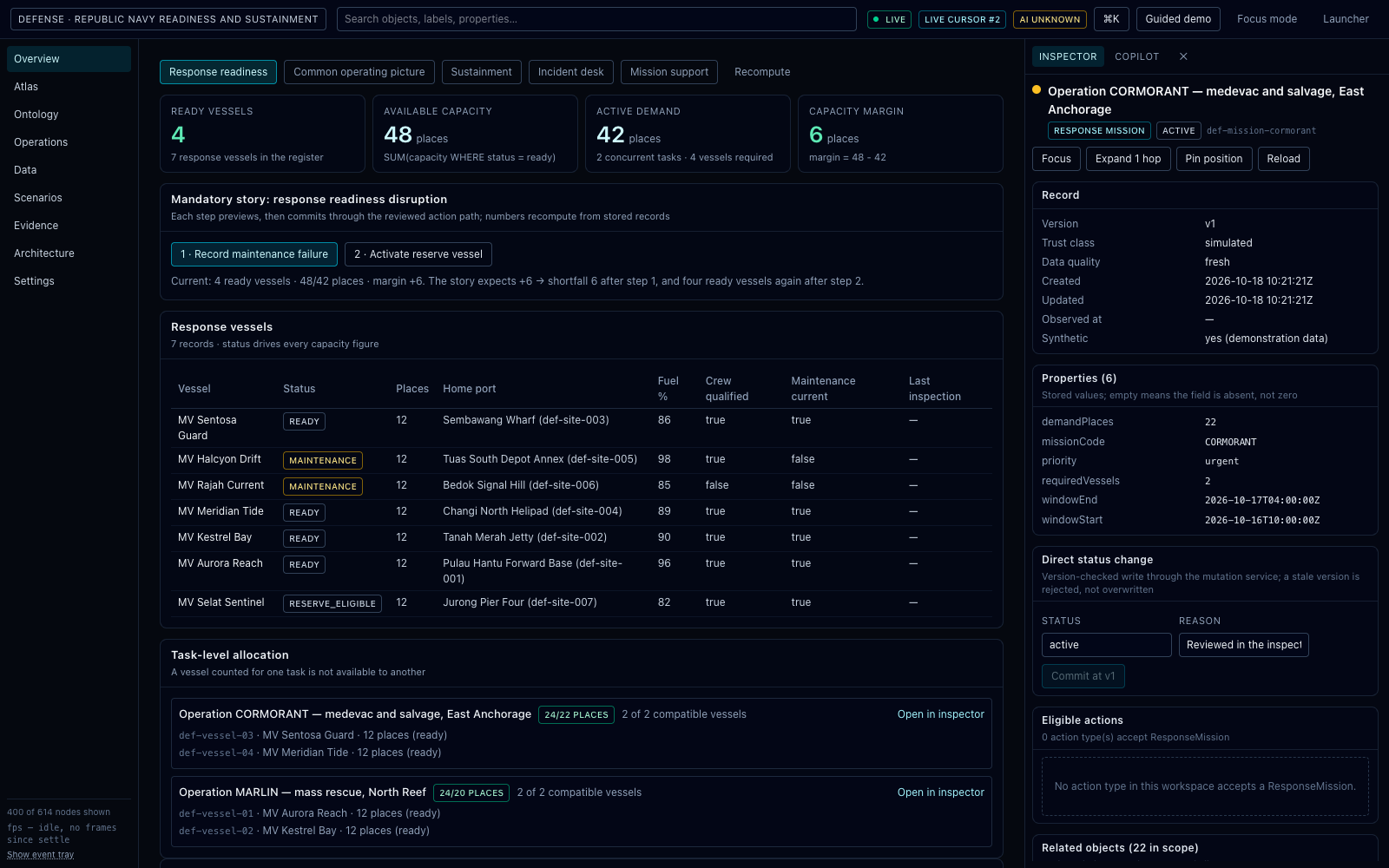
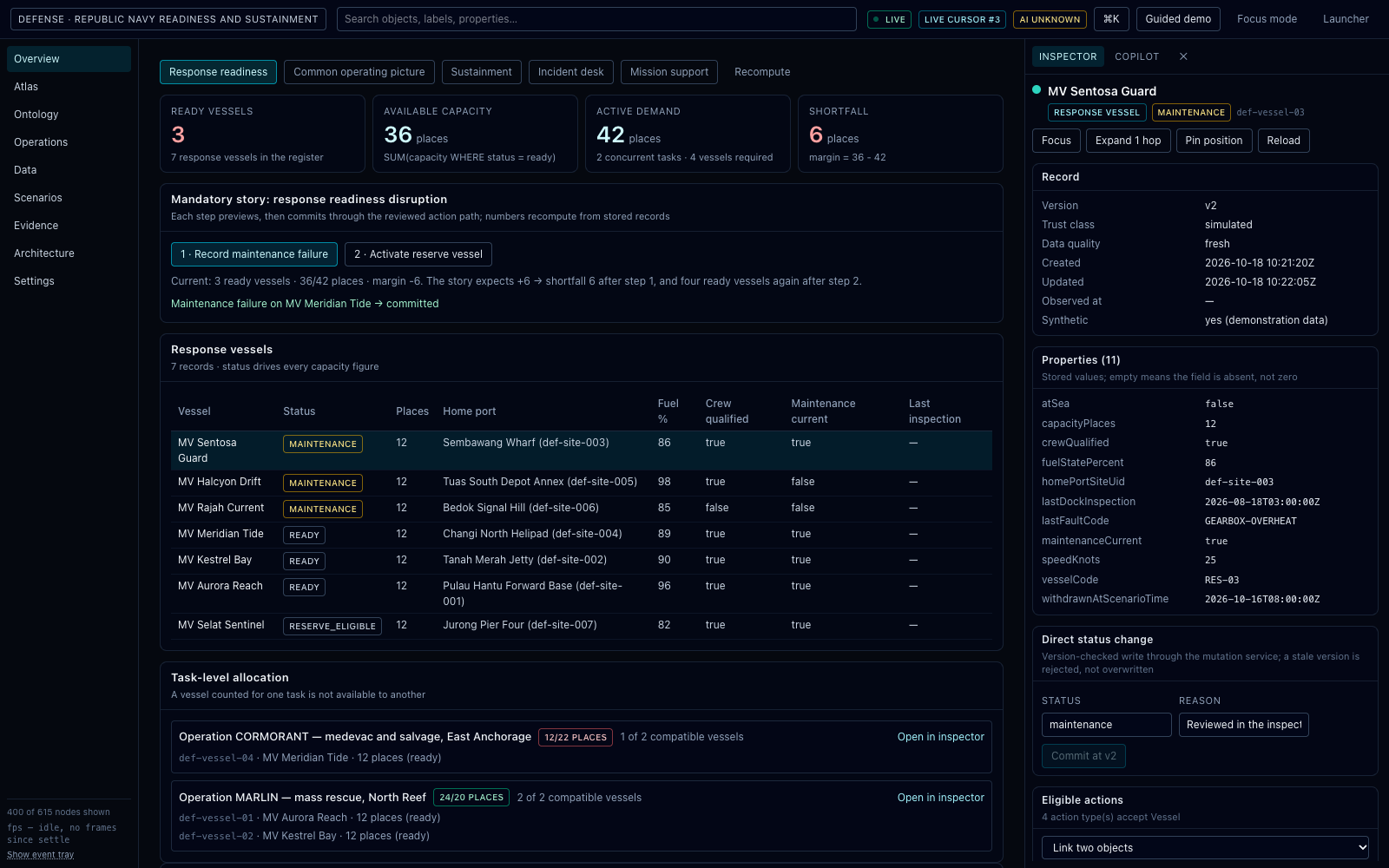
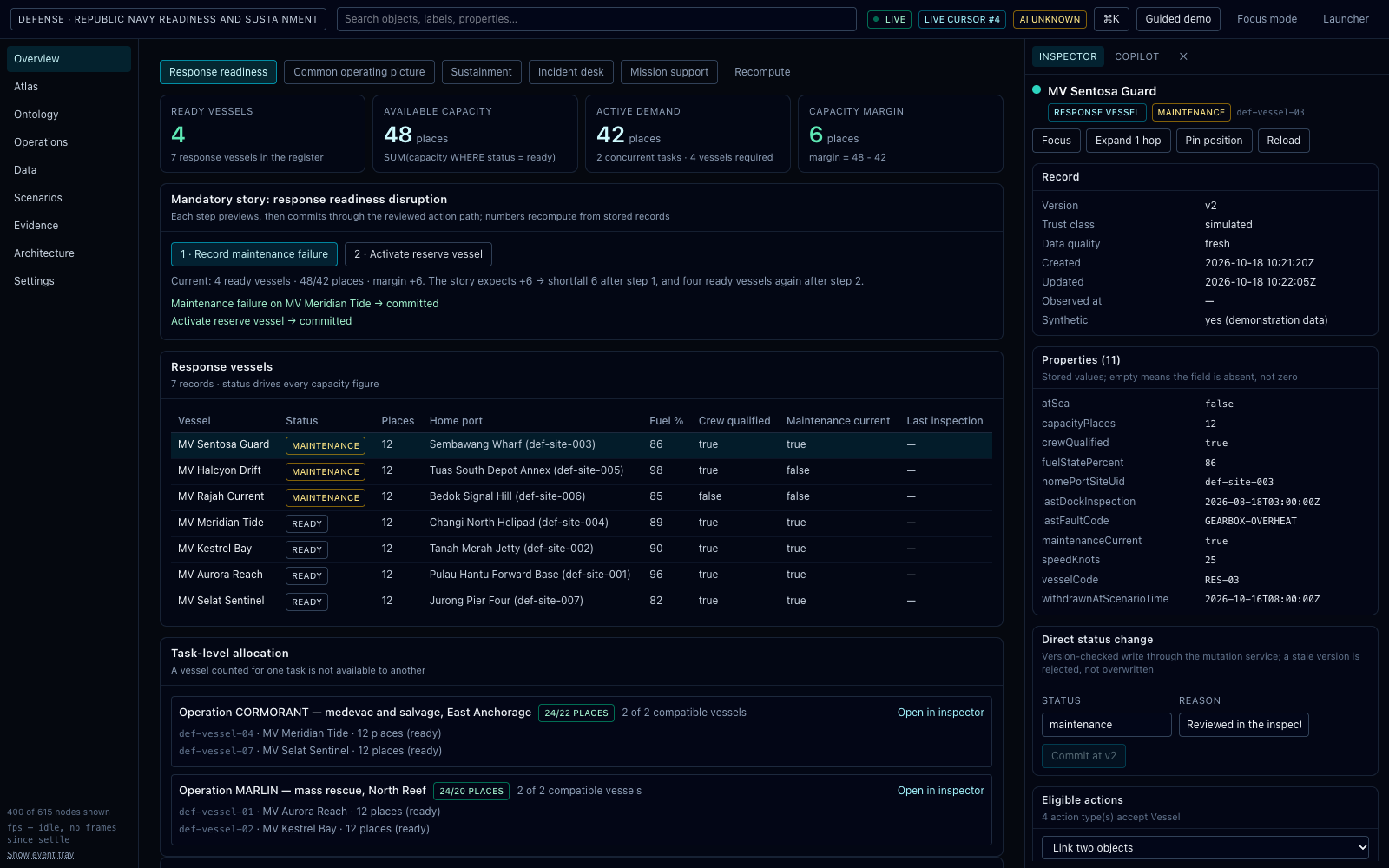
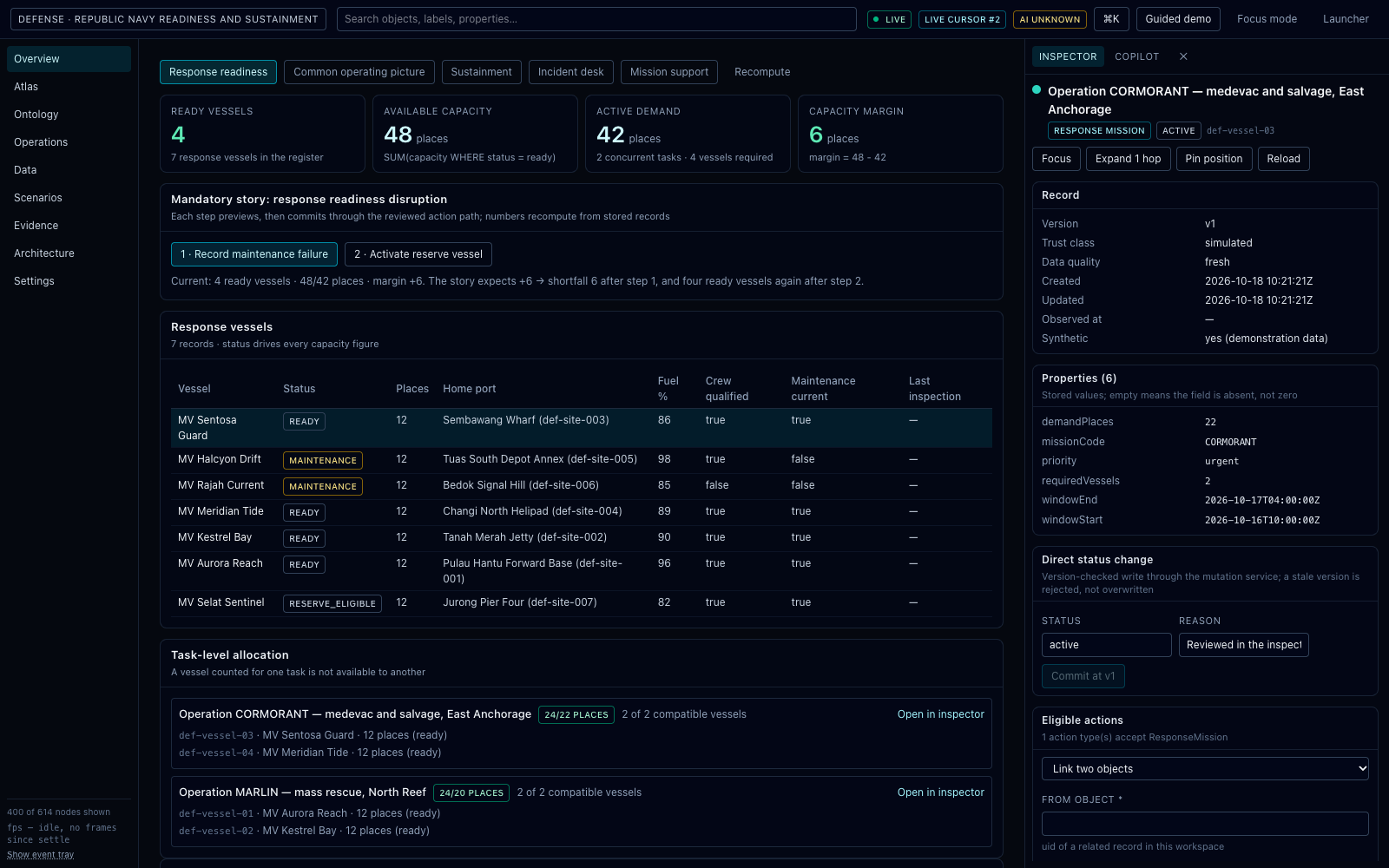
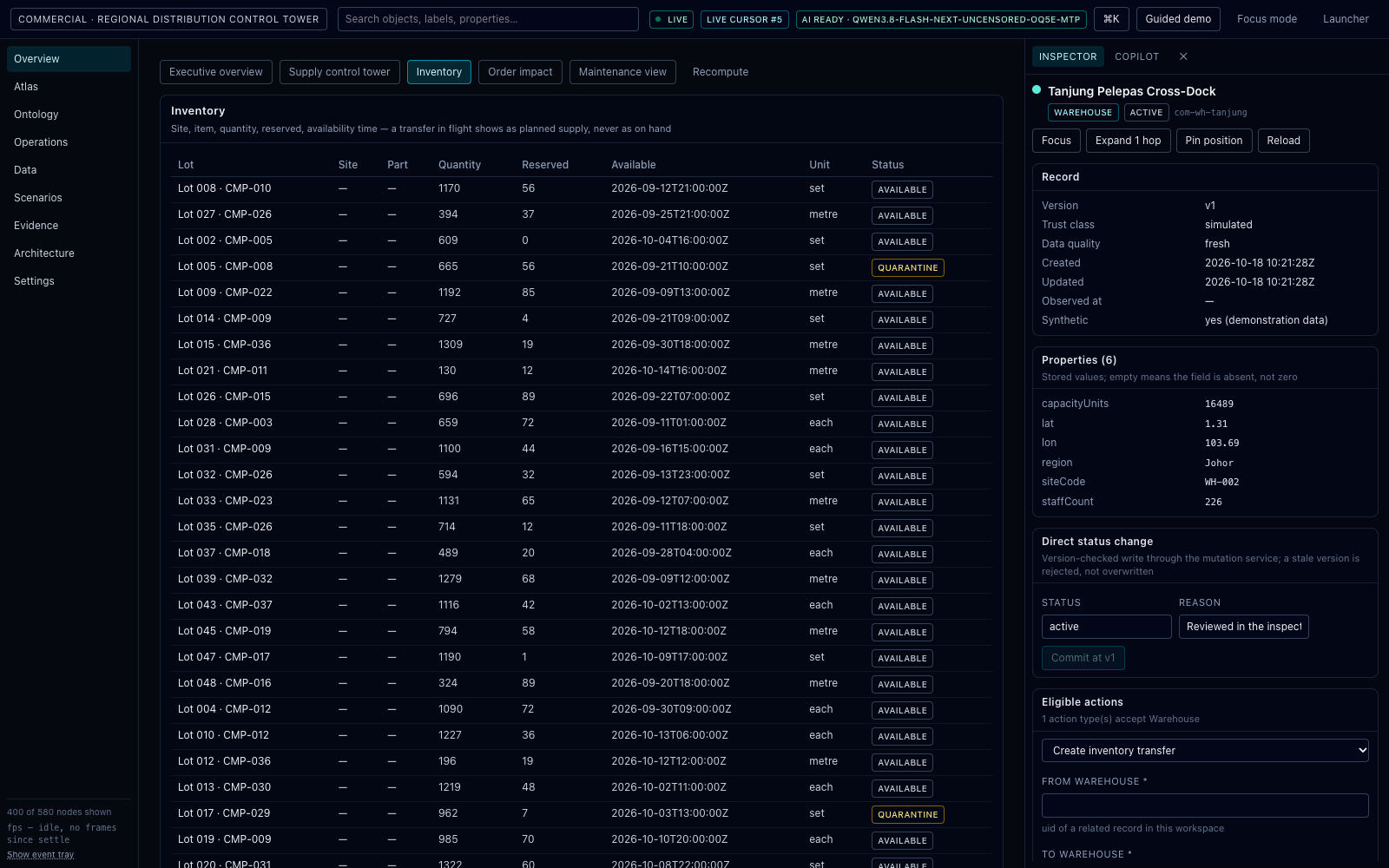
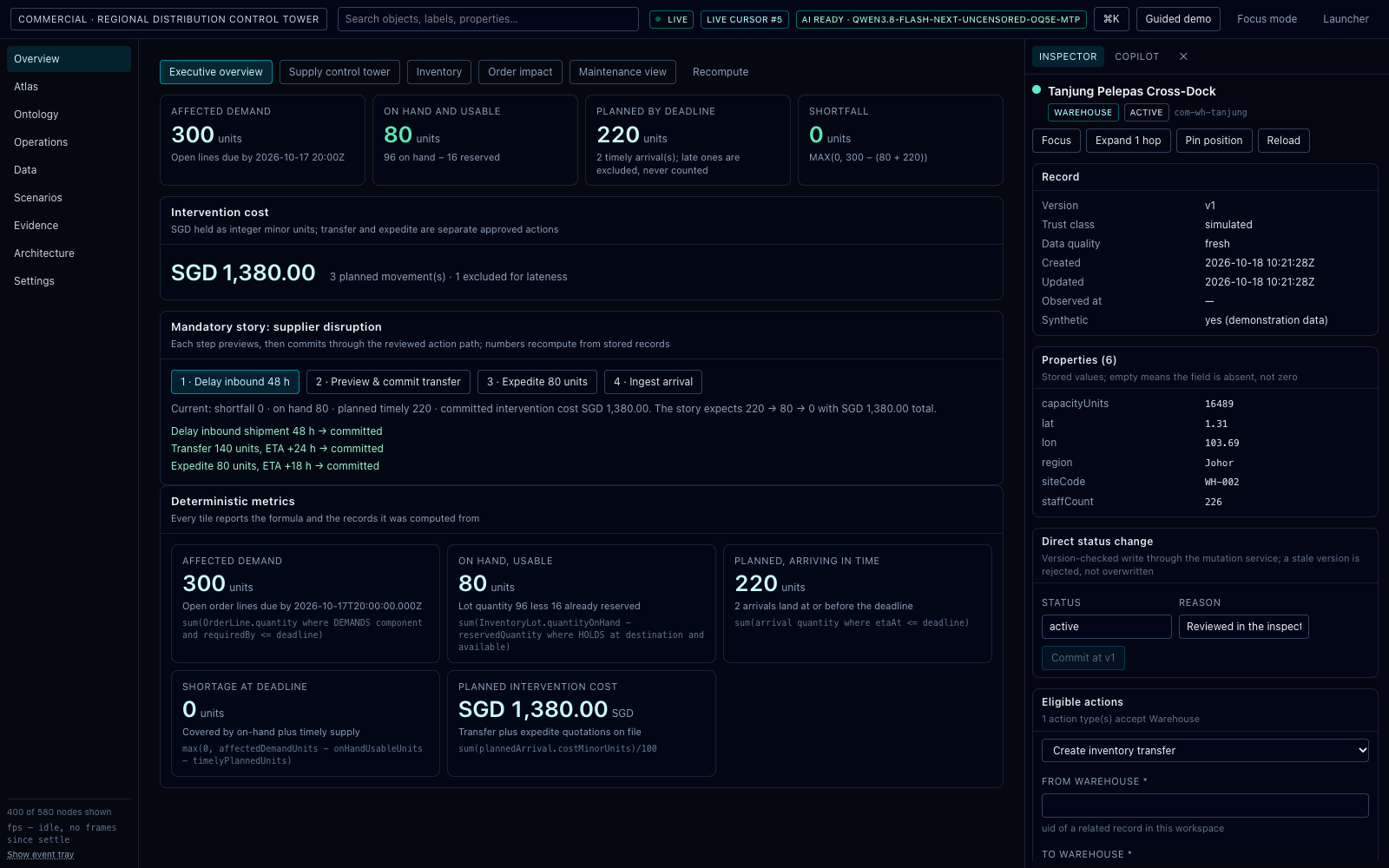
The product, as it actually renders
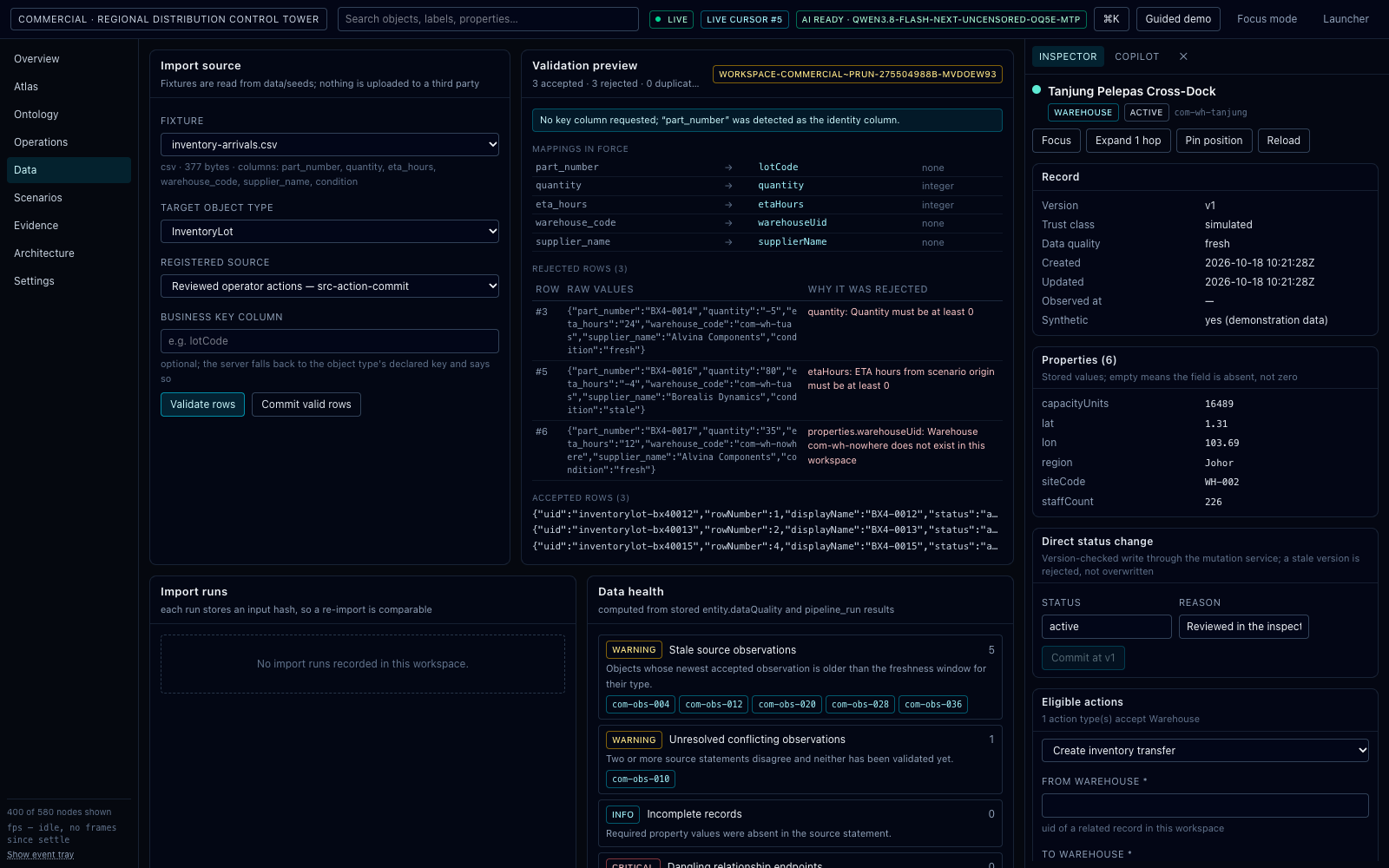
Captured from the running application at 1600×1000. No mockups, no composited dashboards.
Scope and permission
A session decides what you can see, and the API enforces it
Workspace scope comes from the session and never from a query string, so an edited URL cannot reach into somebody else's data. Cross-workspace reads, evidence, actions and live updates are all refused, and that refusal is one of the asserted journeys.
| Role | Granted |
|---|---|
| viewer | Read snapshots, search, inspect, follow the live stream. |
| analyst | Everything a viewer can do, plus scenario branches and previews that write nothing. |
| operator | Create and update entities and relations; run and commit reviewed actions; ingest arrivals. |
| owner | All of the above plus workspace and ontology changes. |
| public URL | Clamped to viewer. A request that arrives through the tunnel cannot mint a stronger session and cannot write — it is told so in the 403, not left guessing. |
Interface
Every surface is one HTTP call away
The UI is a client of the same API it ships with, same-origin, so the browser never holds a credential and never talks to a second backend.
| Method | Path | Contract |
|---|---|---|
| GET | /api/graph | The one snapshot contract. Filtered, bounded, and identical to what the table and inspector read. |
| GET | /api/search | Bounded entity search over the current workspace. |
| GET | /api/entity/:uid | One record with its evidence and links. |
| GET | /api/stream | Server-sent events carrying invalidation only — never a payload an attacker could invent. |
| GET | /api/actions | Action types with their preconditions, split into blocking and advisory. |
| POST | /api/actions/:type/preview | Compute the consequence and write nothing. |
| POST | /api/actions/:type/commit | Apply it with an idempotency key; a replay duplicates nothing. |
| POST | /api/ingest/preview | Validate a payload against the ontology and report every reject by name. |
| POST | /api/copilot | Grounded question answering; the answer names its sources and its model. |
| POST | /api/scenarios/:uid/compare | Branch versus reality, field by field. |
The live stream carries invalidation only: event: invalidate with a workspace id, a journal cursor and a reason. The client then refetches the snapshot it is allowed to see, so a forged event can cause a refresh but never inject a fact.
Open the atlas and click around
The public deployment is the real application in read-only mode — pick a pack, drag the globe, ask the copilot a question and follow its citations.